This chart via Jon Chait illustrates everything you need to know about the ultimate impact of Reaganomics. In short: the working and middle classes were totally hosed.
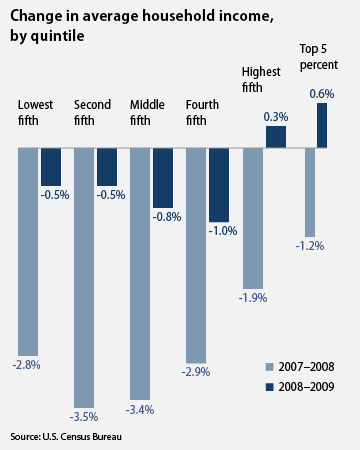
Chait: "The remedy, of course, is to cut tax rates for the highest-earning 2%."
PolitiFact
In 1983, Reagan signed legislation aimed at preserving Social Security's solvency by raising payroll taxes and taxing Social Security benefits of upper-income Americans.
The plan certainly preserved Social Security but also demonstrated that Reagan was willing to impose tax increases, even if he didn't propose them and rarely accepted them with enthusiasm.
As former Reagan adviser Bruce Bartlett wrote in a 2003 article for National Review, Reagan signed two major tax increases in 1982 that took back much of the break he'd provided in his 1981 tax bill. After the Social Security tax increase of 1983, Reagan approved further tax increases — in one form or another — in 1984, 1985, 1986 and 1987.
None of them was particularly draconian and taxes as a share of GDP continued to decline until 1984, when they bottomed out at 18.4 percent but then rose back to 19.2 percent by 1989, when Reagan left office. The overall percentage then was still lower than during Reagan's first year in the White House.
Still, the fact that Reagan signed legislation raising taxes at all during his presidency certainly runs counter to the current GOP orthodoxy and would seem to contradict, if not disprove, McCain's statement, which we find to be Barely True.
Krugman (2004)I'll remind you that in 2009, Americans paid the lowest tax rate in 50 years, 9.2% of all income. In the Reagan years of 1981-89, the lowest rate paid was 13.1%.
The first Reagan tax increase came in 1982. By then it was clear that the budget projections used to justify the 1981 tax cut were wildly optimistic. In response, Mr. Reagan agreed to a sharp rollback of corporate tax cuts, and a smaller rollback of individual income tax cuts. Over all, the 1982 tax increase undid about a third of the 1981 cut; as a share of G.D.P., the increase was substantially larger than Mr. Clinton's 1993 tax increase.
Mr. Reagan's second tax increase was also motivated by a sense of responsibility -- or at least that's the way it seemed at the time. I'm referring to the Social Security Reform Act of 1983, which followed the recommendations of a commission led by Alan Greenspan. Its key provision was an increase in the payroll tax that pays for Social Security and Medicare hospital insurance.
For many middle- and low-income families, this tax increase more than undid any gains from Mr. Reagan's income tax cuts. In 1980, according to Congressional Budget Office estimates, middle-income families with children paid 8.2 percent of their income in income taxes, and 9.5 percent in payroll taxes. By 1988 the income tax share was down to 6.6 percent -- but the payroll tax share was up to 11.8 percent, and the combined burden was up, not down.
Nonetheless, there was broad bipartisan support for the payroll tax increase because it was part of a deal. The public was told that the extra revenue would be used to build up a trust fund dedicated to the preservation of Social Security benefits, securing the system's future. Thanks to the 1983 act, current projections show that under current rules, Social Security is good for at least 38 more years.
Do you really think that you could have Anti-Government Republicans in charge for 30 plus years and actively working to destroy the infrastructure of government without causing system failures? If you do, then you are living in candy land (or a tea infused lotus dream).
The oil spill in the gulf is is just another result of snorting deregulation fairy dust with a Markets-Are-God hi-ball chaser night after night for decades. When you let industry capture regulators and dismantle effective governance, you guarantee a catastrophic failure. The spill is evidence of this, so was that mining disaster in West Virginia, same thing when it comes to that financial meltdown and the same thing will be true when the next system fails.

Ezra Klein
This graph, from EPI, is probably the sort of thing most of you have seen before.
The normal takeaway from this is that the American economy is very unfair. But I don't think that's a sufficient conclusion. Rather, there's something dangerous in these lines. One of two things happen when the majority of a country goes through a sustained period of wage stagnation. Either political unrest reaches destabilizing levels or we mask the trend by amassing enormous amounts of debt so that people can spend more and have more services even as they're making less and the government is getting less in revenue. The outcome of that latter approach, of course, is a debt bubble, and we're enduring the aftermath of one of those right now.
So much as there's been real energy devoted to averting total financial collapse and mitigating the recession, there's really not been that much energy left over for figuring out how to rebuild an economy that shares its gains. Quite the opposite, in fact. Wall Street and high-end industries are either rebounding or were never hit very badly, while middle-class workers are still in terrible straits. There might not be much that we can do about this until economic growth returns and we can see what the economy looks like once it's settled back down, but if we're to avert either more bubbles or a much more gruesome level of political division, people better start considering it.


 Posts
All Comments
Posts
All Comments


